women seeking men
women seeking men |
- Research: Men and Women Need Different Kinds of Networks to Succeed - HBR.org Daily
- The military’s male-only draft registration requirement is unconstitutional, a judge ruled. What comes next is unknown. - The Washington Post
- Transgender inmate sues IDOC, seeks transfer to women’s prison - Chicago Sun-Times
- The U.S. Teaching Population Is Getting Bigger, and More Female - The Atlantic
- Who Are the Women Running for President in 2020? Meet the Female Candidates Vying for the Oval Office - MarieClaire.com
| Research: Men and Women Need Different Kinds of Networks to Succeed - HBR.org Daily Posted: 25 Feb 2019 07:07 AM PST  We know that social networks are critical to professional advancement. We also know that men are more likely to rise to leadership positions. This makes one wonder: Is there a difference between the networks of successful male and female leaders? Recent research I conducted with collaborators Yang Yang and Nitesh V. Chawla suggests there is. We studied what types of networks helped new male and female MBAs land executive leadership positions. We found that men benefit not so much from size of network but from being central in the MBA student network—or connected to multiple "hubs", or people who have a lot of contacts across different groups of students. Women benefited in terms of post-MBA job placement from being central in the network too; but to achieve the executive positions with the highest levels of authority and pay they also had to have an inner circle of close female contacts, despite having similar qualifications to men including education and work experience. Why the difference? Being central gives male or female students quick access to varied job market information—such as who's hiring, what salaries are offered at different firms, how long it takes to get promoted, how to optimize their resumes—that is public but tends to be scattered widely among students in the class. Being central puts dispersed information in ready reach. However, because women seeking positions of executive leadership often face cultural and political hurdles that men typically do not, they benefit from an inner circle of close female contacts that can share private information about things like an organization's attitudes toward female leaders, which helps strengthen women's job search, interviewing, and negotiation strategies. While men had inner circles in their networks too – contacts that they communicated with most – we found that the gender composition of males' inner circles was not related to job placement. The Power of Direct PlacementWinning placement into executive leadership positions directly out of graduate school benefits men and women alike. Early-career women, especially, can use this route to sidestep longstanding labor-market challenges, including stereotyping and discrimination, which result in lower pay, lesser advancement opportunities, and a higher rate of dropping out of the labor market altogether. But little is known about the links between graduate school and placement into these positions. We wanted to understand whether one's network enables MBAs to find the right opportunities, setting the stage for successful careers. To connect features of social networks at school to job placement success, we analyzed 4.5 million anonymized email correspondences among a subset of all 728 MBA graduates (74.5% men, 25.5% women) in the classes of 2006 and 2007 at a top U.S. business school. We measured job placement success by the level of authority and pay each graduate achieved after school. Men Need CentralityWe found that the social networks of men and women MBA students affected their post-graduation job placement. Men who had the most centrality (top quartile) in the MBA student network tended to perform best in the job market, securing jobs with more authority and pay (1.5 times greater) than their peers with the least centrality (bottom quartile). High centrality drove their placement even after controlling for individual characteristics, such as undergraduate GPA, test scores, sociability, country of origin, and work experience. Why? Centrality is positively correlated with accessing job market information. Even though much of this is publicly available online, it can be much faster to get the information you need from different MBA students who have contacts across various groups of students who are familiar with employers you're interested in. Women Need Dual NetworksOur results suggest that successful women have high centrality like successful men, but they differ in that they also maintained a close inner circle of female contacts. Although we could not review the content of email messages, we believe that this close inner circle of women likely provides critical private information on job opportunities and challenges. This private information might be about whether a firm has equal advancement opportunities for men and women, or whether an interviewer might ask about plans to start a family and the best way to respond. Women who were in the top quartile of centrality and had a female-dominated inner circle of 1-3 women landed leadership positions that were 2.5 times higher in authority and pay than those of their female peers lacking this combination. While women who had networks that most resembled those of successful men (i.e., centrality but no female inner circle) placed into leadership positions that were among the lowest in authority and pay. Women's success also depended on a certain kind of inner circle. The best inner circles for women were those in which the women were closely connected to each other but had minimal contacts in common. For example, if Jane is a second-year MBA student whose inner circle includes classmates Mary, Cindy, and Reshma, but these three women each have networks with few overlapping contacts, then Jane will benefit not only from her three inner-circle-mates but also their non-overlapping contacts. Interestingly, we found that the gender composition of men's networks didn't matter for job placement. This pattern most likely occurs because men don't need the kind of gender-related private information that women need to navigate male-dominated professions. Despite persistent perceptions of the Old Boys' Club in work settings, we found no evidence for it in our study of graduate school networks. Network Smarter, Not HarderOur findings suggest that women can benefit from taking a strategic approach to networking. First seek quality over quantity in your overall network. Remember: centrality, in this context, is less a function of how many people you know but who those people are. Identifying and connecting with people who are connected to multiple networks is a key strategy. Related to that point is the idea of embracing randomness. The more you associate with similar-minded or experienced people, the less likely you will be to diversify your network and inner circle. Because we tend to target actively when we network, we are prone to restrict targeting to people most like ourselves. How do you break the pattern? Try random selection. We found that the random sorting of business-school students into sections, for example, raised the odds that female students will befriend those with experience and goals beyond their own, again expanding their knowledge and contacts in career-enhancing ways. Randomness democratizes the networking process, ultimately enhancing it. Finally, beware a closed inner circle. When your inner circle is too interconnected—the people within it are similar and have similar contacts—it can feel socially secure but fail to generate key insights and opportunities. Workplace or industry affinity groups, for example, become closed structures in many cases. There's nothing wrong with being part of such group, but try to complement it with others representing more diverse experience and connections. Employers, too, can aim to create more diverse small groups, to promote the development of women. Rather than creating just an affinity group of female coders, for example, populate a separate group with members from a cross-section of the organization that increase the chances of making unexpected connections, to better inform and support individuals. Our study suggests that women face a greater challenge in networking to find professional opportunities – they, more than men, need to maintain both wide networks and informative inner circles in order to land the best positions. The good news is that by taking a smart approach, women can continue to find meaningful advancement options, while helping their peers and more junior contacts do the same.  |
| Posted: 25 Feb 2019 11:27 AM PST A federal judge's ruling that it is unconstitutional to require men, but not women, to register for a draft into the U.S. military has revived a debate about whether the system should be altered or ended. But the decision, which does not order the government to revise the registration requirement, also raises a question: What happens next? The Selective Service System, created at the outset of World War I, requires men ages 18 to 25 to register and was last used to send draftees to combat during the Vietnam War. But whether it is constitutional has been debated for years, especially after the Obama administration in 2015 rescinded a policy that prevented women from serving in most ground-combat roles. [Senate panel endorses women in the draft, making policy change more likely] U.S. District Judge Gray H. Miller said in his ruling Friday that times have changed and the government can no longer justify the male-only system's "gender-based discrimination." "While historical restrictions on women in the military may have justified past discrimination, men and women are now 'similarly situated for purposes of a draft or registration for a draft,' " Miller, a judge in Houston, wrote in his 19-page opinion . "If there ever was a time to discuss 'the place of women in the Armed Services,' that time has passed." The decision is unlikely to be the last word in the long-running debate. The case was brought by the National Coalition for Men, a nonprofit men's rights organization, and two draft-aged men, one in Texas and the other in California. "This ruling is going to force the government eventually to either get rid of the selective service requirement or require both sexes to register. It's got to be one or the other," said the coalition's attorney, Marc Angelucci. A similar case, pending in federal court in New Jersey, was brought by a young woman seeking to register for the draft. She has also challenged the constitutionality of the male-only requirement. The cases come as the National Commission on Military, National, and Public Service, formed in 2017, interviews Americans about how they view the Selective Service System and prepares recommendations due to Congress next year about what to do with the draft and how to make national service more desirable. Joe Heck, the commission's chairman, said Monday in an interview that the group has been monitoring both court cases and the decision Friday makes its work more relevant. Research has shown that a small majority of Americans believe that women should register for the draft, and the information the commission has gathered anecdotally backs that, he said. But Heck, a one-star general in the Army Reserve and a former Republican congressman from Nevada, said that many Americans are entrenched in their positions, often falling along generational lines. "It does seem like the folks for and against fall into two distinct groups," he said. "The younger folks — the 18- to 25-year-olds — are all saying that, yes, women should have to register. That it's a matter of equality — and that's both males and females. But when you get to an older demographic, those are the ones who are more reluctant to have women register. Those are the ones saying, 'Don't draft our daughters.' " A Pentagon spokeswoman, Air Force Lt. Col. Carla Gleason, referred questions about the ruling to the Justice Department. "We need and appreciate every qualified patriot who is willing and able to serve," she said. The Justice Department declined to comment or to say whether the government would appeal. Because the decision does not include an injunction blocking the government from continuing with the requirement, the question remains: "How do you fix this?" said Eugene R. Fidell, who teaches military law at Yale Law School. "By getting rid of draft registration for everybody or imposing draft registration for women? The judge hasn't ruled on that," he said. "Either of those outcomes would satisfy an equal protection claim." [Are women headed for the draft? Support for the idea grows in Congress.] Government lawyers had urged the judge to defer to Congress on military affairs and to put off a decision while the national commission considers whether lawmakers should revise draft registration requirements. But Miller, who was appointed to the bench by President George W. Bush, noted in his ruling that the commission is not due to issue a final report until 2020 and that Congress has debated the requirement "for decades with no definite end in sight." Miller acknowledged that his ruling is at odds with a 1981 Supreme Court decision that upheld the constitutionality of a male-only registration requirement. But the high court's holding in Rostker v. Goldberg is not directly on point, the judge found, because women are now eligible to serve in combat roles. In December, Ash Carter, the former Pentagon chief who opened combat jobs to women, said in a report for the Harvard Kennedy School that the question about whether women should register for the draft "arose immediately" after the combat-exclusion policy was rescinded. "At the time, I said that it stands to reason that if women are admitted to all positions in the military, they should be subject to the draft," he wrote. "However, the law remains that women are not currently required to register. In fact, it does not matter much to me, since I do not want a draft. I want to be able to pick who joins us." The top officers in the Army and Marine Corps, Gens. Mark A. Milley and Robert B. Neller, also have said they are in favor of women registering for the draft. A number of advocates for women serving in the military, including the Service Women's Action Network, have argued for female registration as an equal rights issue. Others have argued that the United States is due to ditch the Selective Service System entirely. Christopher Preble, a Navy veteran and defense analyst with the libertarian Cato Institute, said Monday that he is glad the debate over whether women should register for the draft has prompted the United States to revisit the need for the system. "We know from bitter experience that the manner in which people are chosen from that pool is not equitable," he said, referring to the ways in which some people avoided military service, including through deferments. "It wasn't in Vietnam, and it wouldn't be in the present era. And so I just don't see the rationale for registration, which implies that every male at that age is expected to be called in service in the event of a national emergency." The coalition and the men behind the court challenge in Texas — Anthony Davis and James Lesmeister — argued that the male-only requirement violated the equal protection clause of the Fifth Amendment. "We take no position on whether there should be a draft," said Angelucci, their attorney. "We just feel if there is a mandatory requirement, it should not be discriminatory based on sex." Correction: Joe Heck is a former congressman from Nevada, not New Mexico. The story has been updated. Read more: Army and Marine Corps chiefs: It's time for women to register for the draft Why the Pentagon opening all Pentagon jobs to women could subject them to a military draft In historic decision, Pentagon opens all jobs in combat units to women Local newsletters: Local headlines (8 a.m.) | Afternoon Buzz (4 p.m.) Like PostLocal on Facebook | Follow @postlocal on Twitter | Latest local news  |
| Transgender inmate sues IDOC, seeks transfer to women’s prison - Chicago Sun-Times Posted: 26 Feb 2019 02:13 PM PST A transgender woman incarcerated at the Pontiac Correctional Center in central Illinois has filed a federal lawsuit seeking a transfer to a women's prison. The Uptown People's Law Center and the MacArthur Justice Center filed a federal suit Tuesday on behalf of 29-year-old Janiah Monroe, according to a statement from the UPLC. The suit names Illinois Department of Corrections Director John Baldwin as a defendant and claims IDOC is violating Monroe's constitutional rights by refusing her 2017 request to be transferred from Pontiac – a men's maximum-security facility – to a women's prison. IDOC denied the request, citing a department policy to house prisoners according to the gender they were assigned at birth, according to the lawsuit. Monroe, who was born Andre Patterson, has been in prison since 2008 after multiple convictions in Cook and Livingston counties on charges including second-degree murder, attempted murder, aggravated battery and attempted aggravated arson, according to IDOC records. She will be eligible for parole in 2051; her discharge date is 2054.  Janiah Monroe | Illinois Department of Corrections "I have been sexually assaulted at every men's prison that IDOC put me into, including by IDOC staff," Monroe said in the statement from her attorneys. "It's time for IDOC to recognize my gender and take responsibility for keeping me safe. As long as I'm in a men's prison, IDOC can never protect me from sexual assault." Her attorneys said her gender dysphoria "is so severe that she has attempted self-castration more than once, made several suicide attempts, and has repeatedly engaged in other forms of self-harm" The lawsuit claims that IDOC officials know transgender women housed in men's prisons are at an increased risk of sexual assault, sexual harassment or suicide and alleges that refusing Monroe's transfer request is a violation of the 14th Amendment's equal protection clause. The suit asks the court to order IDOC to transfer Monroe to a women's prison and provide her with "adequate mental health services" in addition to seeking court fees, expenses and damages. Spokeswoman Lindsey Hess said IDOC "cannot comment on pending litigation" but added that the department "carefully considers housing assignments and works with a committee comprised of medical, mental health and security professionals when making placements for transgender offenders." Strawberry Hampton, a transgender woman previously incarcerated at the Logan Correctional Center and also alleged multiple instances of abuse at men's prisons, was moved to a women's facility last year after a year-long legal battle.  |
| The U.S. Teaching Population Is Getting Bigger, and More Female - The Atlantic Posted: 20 Feb 2019 09:59 AM PST 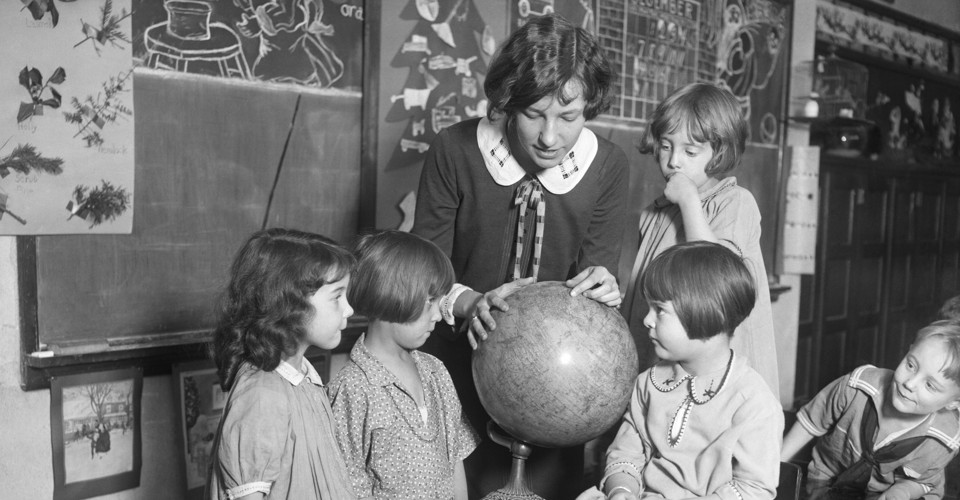 Teaching in the United States was once considered a career for men. Then the profession's gender composition shifted dramatically around the mid-19th century, when the country's public-school system was born. As schoolhouse doors opened to children of all social classes and genders, so too did the education profession. By the late 1880s, women made up a majority—63 percent—of all the country's teachers (though men continued to make up most of the high-school teaching force until the late 1970s). Within a few decades, the choice to teach young children was solidified as an inherently "feminine" pursuit; in fact, girls who couldn't or didn't want to be homemakers had few other job options. In the mid-20th century, however, cultural and political shifts prompted a surge in the number of women seeking employment in traditionally "masculine" sectors. These changes also prompted the reverse—albeit to a lesser extent: The number of men seeking classroom careers rose and has grown by 31 percent since the early 1980s. Yet despite this, the gender distribution in the profession has strangely grown more imbalanced, according to recently released data, largely because women are still pursuing teaching at far greater rates than men. According to the study, led by the University of Pennsylvania professor Richard Ingersoll, the nation has witnessed a "slow but steady" increase in the share of K–12 educators who are women. During the 1980–81 school year, roughly two in three—67 percent—public-school teachers were women; by the 2015–16 school year, the share of women teachers had grown to more than three in four, at 76 percent. (From 1987 to 2015, the size of the teaching force increased by more than 60 percent, from about 2.5 million to about 4.5 million, according to the recent report, which helps explain why the field tipped further female despite the rising number of men in the profession.) The trend is "odd," Ingersoll and his co-authors—all education scholars, and most of them former classroom teachers—write in the report. Generally speaking, starting in the 1970s the country's occupations witnessed a significant decline in gender segregation, as the number of women in the workforce soared. An index that measures how many women or men would need to change jobs to achieve equal gender distribution across occupations fell 26 percent from 1972 to 2002, when it was at its lowest point, according to a 2010 report by the Institute for Women's Policy Research. Ingersoll and his research team highlight the rising proportion of women who are, for example, physicians (from 10 percent in 1972 to 40 percent in 2018, according to Bureau of Labor Statistics data and federal surveys), lawyers (from 4 percent to 37 percent over the same time period), and pharmacists (13 percent to 63 percent). Other research shows that fewer female college students are seeking teaching degrees: In the late 1970s, roughly a third of the women enrolled in U.S. colleges were majoring in education; today the share has dropped to 11 percent. What explains these contradictory trends? Much of it comes down to misunderstandings of what teaching entails and how those assumptions intersect with gender norms. Unlike in many other countries, in the United States, teaching has long been seen as a relatively low-status profession. In 2018, a survey of people in roughly three dozen countries asked respondents to rank 14 different professions—including teaching, medicine, law, social work, and website engineering—by each career's perceived social status. On the one hand, survey participants in the United States gave teachers a middling ranking, and tended to liken them to librarians; respondents in countries such as China and Malaysia, on the other hand, put teachers in first place, analogizing them to doctors. This cultural disregard for teaching has a gendered consequence: The status of a given career tends to correlate with the share of men in that profession—higher status equals more men, generally speaking. And that has its own consequence: Research has found that employers place less value on work done by women than on that done by men. These trends reinforce each other in perpetuity. Within a given field, the more prestigious positions attract more men. Notably, close to half of all principals today, including two-thirds of those serving high schools, are men, as are more than three-quarters of school-district superintendents. Additionally, nine in 10 elementary-school educators are women, according to Ingersoll's study, compared with six in 10 of their high-school counterparts. Prekindergarten in particular is heavily dominated by women, perhaps because younger kids might be dismissed as requiring little more than "Wheels on the Bus" sing-alongs. Julio González, a 23-year-old pre-K educator at a public bilingual school on Chicago's Lower West Side, admitted that he bought into such stereotypes when Teach for America first offered him the job a little more than a year ago, straight out of the University of Texas at Austin. "I made sure to ask people, like, 'Is this an actual job, or am I just a glorified babysitter?' " he recalls. A first-generation Mexican American who dreamed of becoming a lawyer so he could advocate for low-income communities like his own, González eventually realized that teaching might be a more effective way to serve those communities. After all, an individual's racial and gender biases tend to develop at a very young age. Prestige is not a merely notional idea, as it tends to correlate tightly with compensation. The fact that prekindergarten classrooms have difficulty "attracting men as early-childhood teachers is hardly surprising," Marcy Whitebook, who co-directs UC Berkeley's Center for the Study of Child Care Employment, said in an email, given that work as a pre-K teacher "is seen as a pathway to poverty." Teachers overall tend to have pretty meager salaries. The ACT, which every year surveys a pool of test-takers on their career aspirations, found that among respondents who said they were "potentially" interested in a job as a K–12 teacher, as opposed to definitely interested or definitely not interested, low pay was the sticking point that made them unsure. Average teachers' salaries have remained essentially flat since the 1990s after controlling for inflation, according to a report published last year by the nonprofit Education Resource Strategies (ERS), and grew just 7 percent in the two decades before that. Using a metric developed by MIT researchers, the ERS report found that in most states, K–12 educators' salaries fall below the living wage. And usually, the younger the students, the lower their teacher's pay, as a 2018 report on early-childhood educators shows. Women might be more willing to accept teaching's low wages because the profession is, in theory, more amenable than other careers to the needs of women. Mothers, for instance, are more likely now than ever before to desire employment, yet still tend to bear most of the child-rearing responsibilities. The school day tends to end two or so hours before that of typical American workers. A 9-to-5 workday, as Kara Voght has reported for The Atlantic, creates a challenge for parents who have to coordinate and pay for child care (or leave their kids unsupervised) during that time gap. The notion that teachers enjoy shortened work days and summers exempt from work-related duties is little more than a myth, but teachers who are parents are often at least on a schedule a little more conducive to their children's needs. Read: What if America's teachers made more money? One effect of the gender imbalance could be that younger students have fewer opportunities to interact with positive male role models. "As a black male teacher, sometimes I feel like a unicorn," said Charles Jean-Pierre, a D.C. Public Schools art and French teacher. He said the black male teachers he had as a child of immigrants in Chicago motivated him to embrace his passion for art and become a teacher himself. "I think it's important for students to experience joy, nurturing, and compassion from men … Male teachers embody hope and love for many students who do not see that on a daily basis [from men] in their homes." But men who do this work might confront wariness about their abilities, or suspicions about their intentions for working with young children. Ingersoll cited research published in one 1993 book about men in traditionally "feminine" occupations finding that among elementary-school teachers, men who were perceived as too "male" were dismissed as incapable of working with young children, while men who weren't "male enough" were suspected of being child molesters. "You have to sort of work it out so you're the right amount of maleness," Ingersoll told me. "It's tiresome, and so a lot of the male elementary teachers say after a while, 'This is just too draining.' " Both González and Jean-Pierre said that they're always aware of the latter concern, ensuring that another adult is always in the classroom and forging strong relationships with parents. But the fact that male teachers have to consider this at all traces back to the entrenched stereotypes that underpin teaching's gender imbalance. Given that low pay—and accompanying low social standing—is both a result of and driving force behind men's underrepresentation in the profession, it stands to reason that salary hikes could help stem the imbalance. A pay bump could in theory spur a virtuous cycle in which greater representation of men in the profession could slowly shift perception, which Ingersoll in 2016 suggested to The New York Times could then beget even greater representation. That said, some research suggests that pay hikes will only go so far in boosting the share of male teachers—attitudes about caregiving will need to change, too. "Two years ago, if someone had told me that the most important role you can play as a teacher is to be a caregiver, I probably would've said, 'Well, that's not what I'm signing up for,' " González acknowledged. Today he—echoing Jean-Pierre—embraces the fact that caregiving is, indeed, integral to his responsibility as a teacher, and that it's just as valuable as all the other parts of his job. We want to hear what you think about this article. Submit a letter to the editor or write to letters@theatlantic.com.  Alia Wong is a staff writer at The Atlantic, where she covers education and families.  |
| Posted: 21 Feb 2019 04:30 AM PST The 2020 race has only just begun, but already it's looking like a vastly different—and better—kind of playing field. For the first time in our nation's history, there is not just one, or even two, or a few, but a record-smashing, can you believe it six women running for president. At press time in mid-February, there were officially more women seeking the Democratic nomination than men: Four senators and one representative as well as spiritual leader Marianne Williamson. Marie Claire went to the Capitol to capture the historic moment by interviewing and photographing the female politicians vying to be leader of the free world. (We arrived right after the government shutdown ended—they had plenty to say about that.)  . We asked these presidential hopefuls about their plans and policies, but what surprised us the most was when we asked them what questions they are asked that a man running for the highest office would never face. Sen. Elizabeth Warren (D-MA) is tired of the doubters who wonder whether a woman could win. "I've never heard anyone ask, 'Can a man win?'" she says. Rep. Tulsi Gabbard (D-HI), an Iraq War veteran, gets: "Are you tough enough? Can you handle the heat?" Please. Sen. Amy Klobuchar (D-MN) is asked how she manages to campaign and parent at the same time. "I have one daughter, and I've been asked that about a hundred times," she says. "All parents balance things, but dads don't always get asked that." Sen. Kirsten Gillibrand (D-NY) is grilled, too, about how she balances family and work. "The truth is," she says, "women have been working since the beginning of time, and we do it well. We can balance our family needs and the work we need to do." Sen. Kamala Harris (D-CA) says she likes to turn the tables when people only ask her about so-called women's issues: "My response is usually 'I am so glad you would like to talk about women's issues, so let's talk about the economy.'" Talk they will; the presidential primary debates begin in June. And when these women—a veteran, a former college professor, two ex-prosecutors, and several mothers—take the stage, we'll be looking at the most representative and diverse candidate pool in history, one that reflects America's population more accurately than ever before. It's momentous, it's exhilarating, and it's about time. —Kayla Webley Adler  . On what we need to do to move forward as a country:"People have to look at each other and find the heart of America again.… I think what we need to remember is that there's so much more that unites us than tears us apart. And once we start thinking like that, then we can take on these big challenges that are in front of us, because, as a nation, we should be governing from opportunity right now, and not just chaos." On the question she gets asked that a male candidate would never be asked:"People say things like, 'Well, do you think you could really be in charge?' 'Do you think you could really win?' I was asked that when I ran for the Senate in the year 2006. I was repeatedly asked, 'Can a woman win?' because two women before me hadn't won and they were very qualified for the job. But still, I would say to them, 'You know, a woman got elected to the Senate from the state of Texas, so I think we can pull this off.'" On the question she wishes she got asked more:"'What do you think we can do to move forward as a country? What are some ideas that can bring people together?' Because so many of the questions you get asked are about dividing people, instead of things that can bring us to common ground, which is the only way we get to higher ground." On why more women should run for office:"We need more women so we reflect the country that we are, but we also need more women because my experience has been they get results. Women in the Senate work better across the aisle. We introduce more bills together, we've been able to get more things passed, so my answer when people say 'Hey, there's too much gridlock,' my answer is: Elect more women." On her number-one issue: "My number-one issue is how we make this country work, not just for this really little slice at the top, but how we make it work for everyone. Because I really believe that chances, that opportunities, shouldn't all just go to the children of those folks. It ought to go to all our kids." On her advice to young women:"When I was running for Senate the first time, back in 2012, I would meet little girls and I always got down on their level and I would say, 'My name is Elizabeth and I'm running for the Senate because that's what girls do.' And then, we would make pinky promises to remember that. Now won't that be fun for president?" On the question she wishes she got asked more:"I wish I were asked about how we're going to make the big changes we need to make. Not the nibbles around the edge, not the here's a piece or here's a piece. But what's it gonna take to make this country really work? Not just for the rich and the powerful, what it's gonna take to make it work for everyone else."  . On her advice to young women:"I want all young women out there to know that you should never listen if someone tells you that you are too young, or that you need to stand aside and wait your turn. I've been told this throughout my life and I have known, as you should, that the most important qualification is what's in your heart, and how you desire to be of service and have a positive impact on those around you." On why she's running for president:"I'm running for president because our country is being torn apart and I know that what we need now more than ever is aloha. Aloha is respect, it's compassion, it's love for others regardless of race, gender, nationality, ethnicity, sexual orientation, religion. Aloha is what can bring us together, because when we stand united there is no challenge we cannot overcome." On her number-one issue:"My number-one issue is ending counterproductive regime change wars, ending the new Cold War that we're facing, and making it so that we do not end up in a nuclear war that completely destroys our country and our future. We need to focus on making sure that we provide peace and prosperity for all people in this country." On the question she wishes she got asked more: "What motivates me. I've served for 15 years in the Army National Guard, deployed twice to the Middle East, and continue to serve as a Major. I've seen firsthand the cost of war. I know who pays the price. This is why I fight so hard for peace, security, and freedom." On her number-one issue:"My number-one issue is making America work for working families. In particular, their needs in terms of economic support and equal access to opportunity. One of my signature initiatives is the Lift Act, which would give families making less than $100,000 a year a $6,000 tax credit that they can receive at up to $500 a month, because in America today, the majority of families are a $400 emergency away from complete catastrophe. And that's not how it should be." On her advice to young women: "What I want young women and girls to know is: You are powerful and your voice matters. You're going to walk into many rooms in your life and career where you may be the only one who looks like you or who has had the experiences you've had. But you remember that when you are in those rooms, you are not alone. We are all in that room with you applauding you on. Cheering your voice. And just so proud of you. So you use that voice and be strong." On why more women should run for office: "More women should run for office, and more women are running for office, and this is so exciting. We have broken previous records—[we now have] more than 100 women in the United States Congress. And more women should run because women are leaders in their families, in their communities, in their neighborhoods, and in society. So we want to see those numbers reflected in the United States Congress, and that means not only that women should run, but that folks should support and encourage women to run for office. Because when we have an equal number of representatives in Congress—equal number meaning representative of who the population is as a whole—we will be better and stronger."  . On her advice to young women:"I want all young women and girls to know that their voice matters, that their view of the world may well be different, and if they aren't being heard, then they can't change the things that are necessary in their communities and in our country. So, be heard. Your voice truly matters." On her number-one issue:"My number-one issue is restoring this government to the hands of the people. If you are unwilling to have a direct democracy, unwilling to restore what's been lost in terms of giving that power back to the people, you will never be able to do the things that need to be done. You need an open government, you need to get money out of politics, you need to change the fact that the powerful interests control everything. And the way to do it is get money out of politics and give that power right back into the hands of Americans." On why more women should run for office:"More women should run for office because our life experiences are different. We may see problems in our communities, in our states, in our country, that perhaps those here in Washington don't see. We all know Washington's broken, and if you want to fix it, you need to change the players list. You need to change who has a seat at the table, who's being heard, and who's able to work on solving our country's greatest problems." Photographs By Heather Hazzan. Hair and Makeup by Carrie LaMarca and Patti Nelson at The Artist Agency; On-set Production by Amelia Fogarty and Justin Gellerson; Special Thanks: Jeff Kent. Visual design by Morgan McMullen.  |

| You are subscribed to email updates from "women seeking men" - Google News. To stop receiving these emails, you may unsubscribe now. | Email delivery powered by Google |
| Google, 1600 Amphitheatre Parkway, Mountain View, CA 94043, United States | |


Comments
Post a Comment